
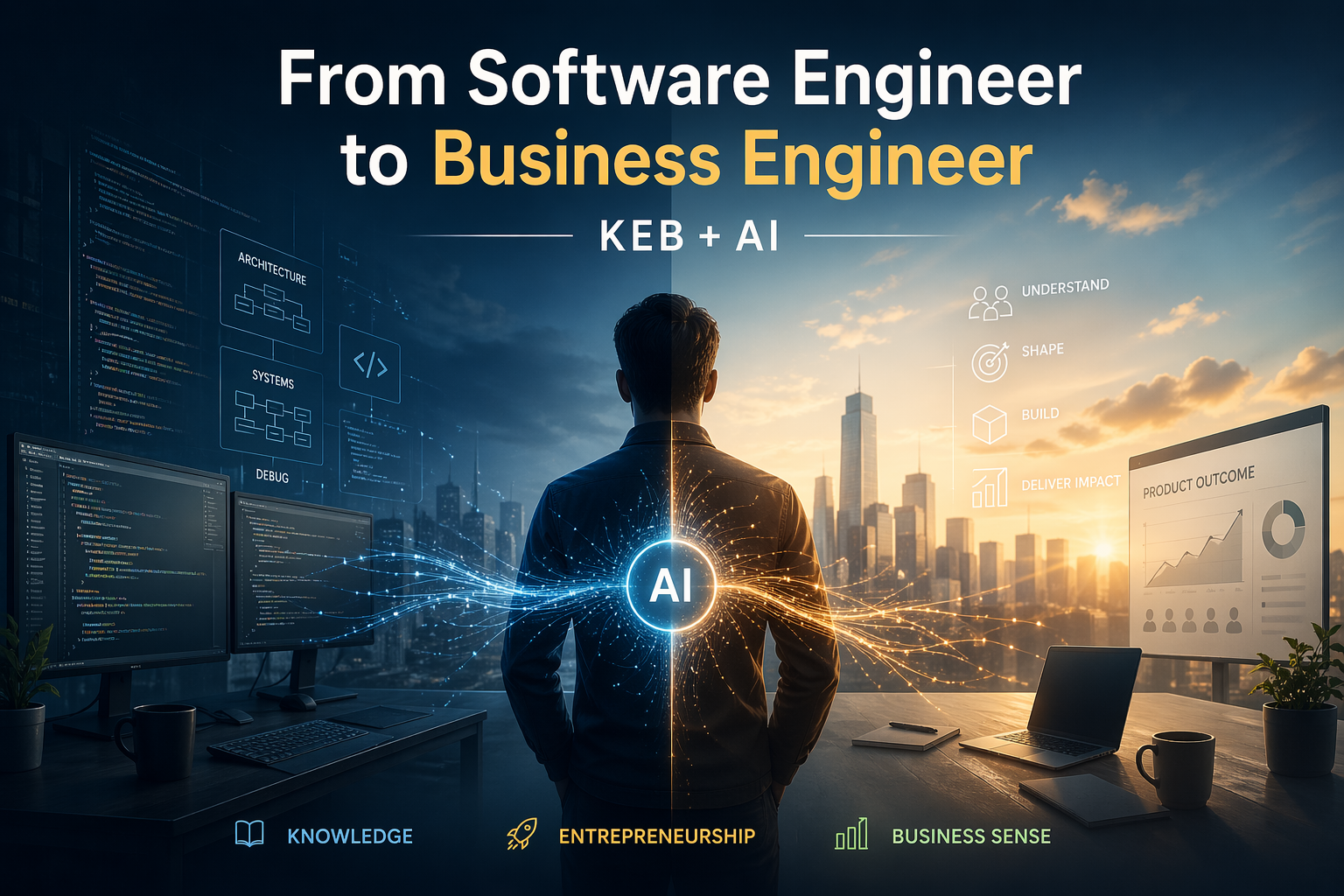
From Software Engineer to Business Engineer
A shift we can’t ignore
Something fundamental is changing in our industry.
For years, we’ve called ourselves software engineers, and that has been the right definition. Not because we wrote code in a specific language or framework, but because we understood systems end-to-end and built meaningful solutions.
From day one, we’ve operated from a simple but deliberate model: the KEB matrix. Knowledge, Entrepreneurship, and Business sense.
In practice, this means that technical excellence alone is not enough. Creating real value requires understanding the business context and having the initiative to act on it. The three dimensions are equally important, and always have been.
But today, even that is no longer sufficient.
Where value is moving
AI is not just changing how software is built. It is shifting where value is created. As more of the implementation, debugging, and repetitive work becomes automated, the bottleneck moves. What matters most is no longer how fast you can write code, but how well you understand the problem and define the right solution.
This is why we are taking the next step.
We no longer describe ourselves as software engineers.
We are Business Engineers.
In simple terms: KEB + AI.
A Business Engineer understands the business, shapes the product, and builds the solution in one continuous flow. Fewer handovers, less friction, and a much tighter connection between idea and outcome.
Rediscovering the craft
On a personal level, this shift has brought something unexpected back: joy.
As someone who started out as a developer, I’ve spent years moving toward leadership, sales, and strategy. But with the current tooling, I’ve found my way back to building. Being able to take an idea and bring it to life without getting stuck in trivial technical hurdles is remarkable. And I hear the same from many experienced engineers. People who, after years of working around constraints, are rediscovering why they started building in the first place.
Engineering still matters, more than ever
This does not make engineering less important. Quite the opposite.
A strong engineering mindset is now critical. Understanding how systems work, what happens under the hood, and where risks and trade-offs exist is what separates signal from noise. AI accelerates everything, but it does not replace judgment.
Garbage in still leads to garbage out. Which means that requirements, structure, and clarity are becoming more important, not less. Translating messy problems into clear scope is quickly turning into a core capability.
A changing role, not a disappearing one
In Stockholm, software developers are already one of the most common professions. That makes this shift particularly significant. An entire category of professionals is now seeing its role evolve in real time.
The change is not binary, and it is easy to oversimplify.
Right now, those gaining the most leverage are often experienced engineers who combine deep technical understanding with curiosity and openness. They push the boundaries of what is possible with AI, while still knowing when to rely on their own judgment. That balance is where real speed and quality emerge.
At the same time, the entry point for junior developers is likely becoming tougher. There is less demand for purely executional work and higher expectations from day one. But the opportunity is still there. Those who actively build understanding across systems, stay curious, and expand beyond pure implementation can progress faster than ever.
This is not about years of experience.
It is about how you choose to evolve.
Uncertainty, responsibility, and reality
It is also important to acknowledge that no one fully knows where this is heading. AI comes with real trade-offs. The infrastructure required to train and run large models consumes vast amounts of energy, and the environmental impact is non-trivial. At the same time, there are economic and geopolitical implications, with much of the current progress concentrated in the US and China. Europe cannot afford to remain a passive observer.
This is not just a technical shift. It is an economic and societal one. And it requires responsibility, not just speed.
What this means in practice
We have never defined ourselves by the code we write.
From day one, we’ve focused on the intersection of knowledge, business, and execution.
What is changing now is that AI amplifies that approach, and makes the gap between builders and value creators even more visible.
That requires people who can understand problems, define solutions, and bring them to life end-to end. People who can move seamlessly between technology, product, and business.
That is what we mean by Business Engineers.
We believe this is where the industry is heading.
And we intend to stay at the forefront of that shift.
